

Exploring the realm of AI in stock market prediction unveils a fascinating landscape where technology intersects with finance. As AI continues to redefine traditional methods, investors are turning to sophisticated algorithms to gain insights and make informed decisions in the ever-evolving stock market.
Overview of AI in Stock Market Prediction
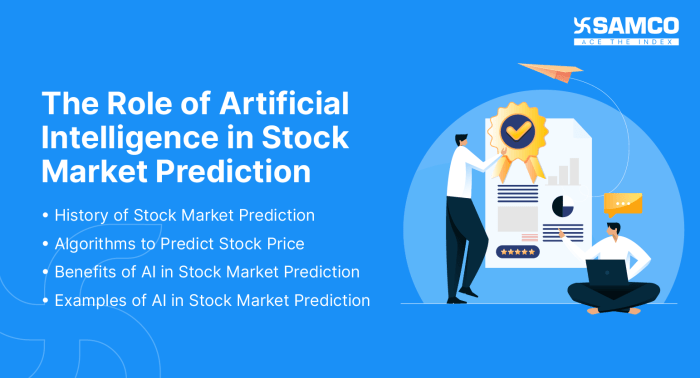
Artificial Intelligence (AI) has been making significant strides in the field of stock market prediction, revolutionizing the way investors make decisions and analyze market trends. Let’s delve into a brief history of AI in stock market prediction, how it is transforming the landscape, and the advantages it offers.
Brief History of AI in Stock Market Prediction
AI has been used in stock market prediction since the 1980s, initially through rule-based systems and statistical models. However, with advancements in machine learning and deep learning algorithms, AI has become more sophisticated in analyzing vast amounts of data to predict stock prices accurately.
How AI is Transforming Stock Market Prediction
AI algorithms have the capability to process enormous datasets in real-time, identifying patterns and trends that human analysts may overlook. By leveraging machine learning models, AI can predict stock price movements with higher accuracy, enabling investors to make informed decisions and optimize their portfolios.
Advantages of Using AI in Predicting Stock Market Trends
- Improved Accuracy: AI algorithms can analyze complex data sets and historical trends to forecast future stock prices more accurately than traditional methods.
- Speed and Efficiency: AI-powered tools can process vast amounts of data quickly, providing real-time insights and enabling investors to act swiftly in dynamic market conditions.
- Risk Management: AI can assess risk factors and market volatility, helping investors mitigate risks and optimize their investment strategies.
- Automation: AI can automate repetitive tasks, such as data analysis and pattern recognition, freeing up human analysts to focus on higher-level decision-making.
Types of AI Techniques Used in Stock Market Prediction
Machine learning and deep learning are two common AI techniques used in stock market prediction. Machine learning involves training algorithms to learn patterns from historical data and make predictions based on those patterns. On the other hand, deep learning uses neural networks with multiple layers to automatically extract features from data and make predictions.
Machine Learning vs. Deep Learning in Stock Market Prediction
In machine learning, algorithms such as linear regression, support vector machines, and random forests are commonly used to analyze stock market data and make predictions. These algorithms require manual feature engineering and are often limited by the complexity of the data.
Deep learning, on the other hand, can handle more complex data by automatically learning hierarchical representations of the data through neural networks. This allows deep learning models to capture intricate patterns in stock market data that may not be apparent to traditional machine learning algorithms.
Natural Language Processing in Stock Market Analysis
Natural language processing (NLP) is another AI technique used in stock market prediction to analyze textual data such as news articles, social media posts, and earnings reports. By processing and extracting information from unstructured text data, NLP algorithms can provide valuable insights into market sentiment, company performance, and other factors that may impact stock prices.
Sentiment analysis, topic modeling, and named entity recognition are some of the NLP techniques commonly employed in stock market analysis.
Neural Networks in Predicting Stock Market Movements
Neural networks play a crucial role in predicting stock market movements by learning complex patterns and relationships in the data. Recurrent neural networks (RNNs) and long short-term memory (LSTM) networks are commonly used for time series forecasting in stock market prediction.
These neural networks can capture temporal dependencies in stock price data and make accurate predictions based on historical trends. Additionally, convolutional neural networks (CNNs) are used to analyze stock market images, such as candlestick charts, to identify patterns and trends that may influence stock prices.
Data Sources for AI Stock Market Prediction
When it comes to AI stock market prediction, the accuracy and effectiveness of the algorithms heavily rely on the quality and variety of data sources used. Different types of data sources play a crucial role in generating insights and making informed predictions.
Real-Time Data
Real-time data is essential for predicting stock market trends as it provides up-to-the-minute information on market activities, stock prices, trading volumes, and other relevant factors. This data allows AI algorithms to adapt quickly to changing market conditions and make timely decisions.
Sentiment Analysis of News Articles
Sentiment analysis of news articles involves analyzing the tone, context, and emotions expressed in financial news to gauge market sentiment. Positive or negative news can impact stock prices and investor behavior, making sentiment analysis a valuable tool for predicting market movements.
Challenges and Limitations of AI in Stock Market Prediction
When it comes to using AI for stock market prediction, there are several challenges and limitations that need to be considered. While AI has the potential to revolutionize the way we predict stock market behavior, it is important to be aware of the constraints and risks associated with its use.
Common Challenges Faced with AI in Stock Market Prediction
- Volatility: The stock market is inherently volatile, making it challenging for AI algorithms to accurately predict price movements.
- Data Quality: AI models heavily rely on historical data, and the quality of the data can significantly impact the accuracy of predictions.
- Complexity: Stock market behavior is influenced by a wide range of factors, making it difficult for AI to capture all the nuances accurately.
- Market Noise: The stock market is filled with noise and random fluctuations, which can lead to false signals and inaccurate predictions.
Limitations of AI Algorithms in Stock Market Prediction
- Overfitting: AI models can sometimes overfit the training data, leading to poor performance on unseen data and inaccurate predictions.
- Black Box Nature: Some AI algorithms operate as black boxes, making it challenging to interpret how they arrive at specific predictions, which can be a limitation in the stock market context.
- Model Bias: AI models can be biased based on the training data they are exposed to, leading to skewed predictions and unreliable results.
Risks Associated with Over-reliance on AI for Stock Market Predictions
- Loss of Human Judgment: Over-reliance on AI for stock market predictions can lead to a loss of human judgment and intuition, which are crucial in interpreting market trends.
- Algorithmic Errors: AI algorithms are not foolproof and can make errors, especially in unforeseen market conditions or outlier events.
- Market Manipulation: There is a risk that market participants could manipulate AI algorithms to influence stock prices, leading to market distortions.
Last Recap
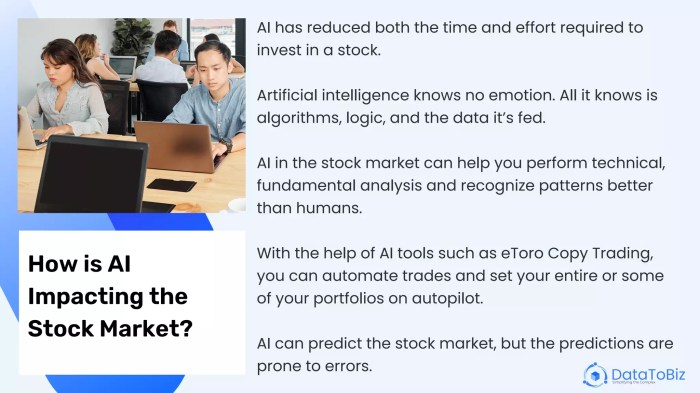
In conclusion, the integration of AI in stock market prediction marks a pivotal shift in the investment landscape, offering unparalleled opportunities for investors to navigate the complexities of financial markets with greater precision and agility. Embracing the power of AI opens new horizons for predicting stock market trends and staying ahead of the curve in the dynamic world of investments.
FAQ Summary
How accurate are AI predictions in the stock market?
AI predictions in the stock market can be highly accurate, especially when trained on extensive datasets and fine-tuned algorithms. However, it is important to note that no prediction method is foolproof, and risks are inherent in financial markets.
What are the benefits of using AI in stock market prediction?
Some benefits of using AI in stock market prediction include faster analysis of vast amounts of data, identification of complex patterns, and the ability to adapt to changing market conditions swiftly.
Can AI completely replace human stock market analysts?
While AI can enhance and streamline the analytical process, it is unlikely to completely replace human stock market analysts. Human intuition, experience, and decision-making skills still play a crucial role in interpreting AI-generated insights and making strategic investment decisions.